
AI Articles Are Transforming Corporate Training
AI-generated articles in 2026: Complete guide to the era of autonomous content
Who writes the internet today? Increasingly, machines do. Artificial intelligence in 2026 has fundamentally transformed how articles are created, distributed, and consumed. This overview maps the current state of AI-generated articles, from hard adoption numbers through qualitative challenges to concrete impacts on corporate training and content strategies. If your organization is considering deploying AI for educational content creation, you'll find essential context here backed by current data and expert insights.
How AI Dominates Content Creation in 2026
AI-driven systems in 2026 generate the vast majority of new internet content. According to Virtuosity Digital, as of February 2026, AI systems create nearly 90% of newly indexed content on the web. This isn't a minor shift; it's a structural change in how information is created and disseminated. And it impacts every organization that relies on digital content for training, marketing, or internal communication.
What does this mean in practice? Content creation costs have dropped by 30-50% according to Virtuosity Digital, while output volume has increased by more than 500%. Impressive numbers. But they bring a fundamental question: how do you ensure quantity doesn't replace quality?
From Chatbots to Autonomous Agents
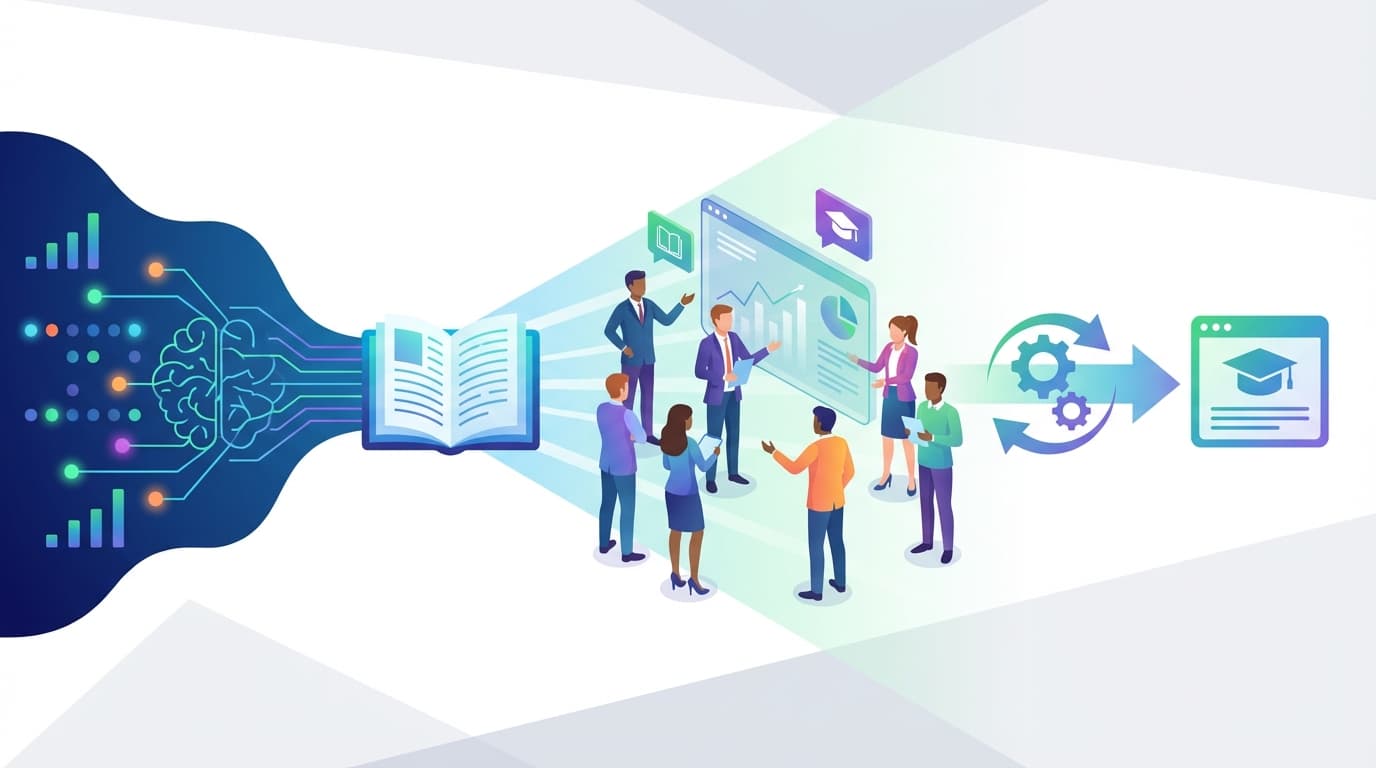
The year 2026 brought a major technological leap. Content creators no longer sit with chatbots refining prompts. The standard has become so-called Agentic Workflows, systems where AI agents autonomously execute entire chains of tasks without human intervention at every step.
According to Master of Code, by the end of 2026, 40% of enterprise applications are expected to contain these task-specific agents. What exactly can they do?
- Independently search the internet and cross-verify facts with current SEO data, for example from Google Search Console.
- Create complex multimodal outputs: one input command now generates an entire "content package" including a long article, LinkedIn post, short video, and podcast episode simultaneously.
- Schedule publication and optimize timing based on analytical data.
As Virtuosity Digital notes, the boundary between text and video in 2026 has practically disappeared. For corporate training, this opens an interesting possibility: one training module can be automatically transformed into dozens of formats tailored to different employee learning styles.
Who Actually Uses AI Content: Adoption Statistics
Generative AI adoption in 2026 is massive. It cuts across demographic groups and industries. According to Digital Silk, by mid-2026, 72% of adults are expected to use generative AI for Search Overviews, which is more than those directly using AI tools themselves.
Generational Differences in Adoption
Gen Z leads the way. According to AmplifAI, 70% of Gen Z members regularly use generative AI tools. For organizations onboarding young employees, this is a key data point. These people simply expect educational content to be personalized, dynamic, and available in various formats. Anything else feels outdated to them.
Investment and Returns
Corporate financial commitments to generative AI are substantial. According to Codegnan, the average large enterprise investment in generative AI reached $110 million USD already in 2024, and this trend continues in 2026.
And the returns? They're measurable:
- Companies using AI in production report an average productivity increase of 24.69% according to Master of Code.
- In the sales sector, professionals using AI report 84% better sales results, as Master of Code states.
For L&D (Learning & Development) departments, this sends a clear signal: investing in AI tools for educational content creation pays off not only in time savings but also in measurable impact on employee performance.
AI Content Quality and the Role of Search Engines
With growing volumes of AI-generated content, search engines have become extremely sophisticated at detecting so-called "empty" content: texts that formally answer a query but provide no original value. This is crucial context for anyone creating AI articles, whether for external publication or internal training.
Emphasis on E-E-A-T
E-E-A-T stands for Experience, Expertise, Authoritativeness, and Trustworthiness, a framework Google uses to evaluate content quality. According to Averi, AI-generated articles in 2026 must be enriched with the human factor, especially the dimension of experience and expertise. Purely machine-generated text without original data or personal anecdotes has minimal search visibility.
What does this mean in practice for corporate training?
- Internal experts must be involved in the content creation process: AI can create structure and first drafts, but experts must add specific examples, case studies, and contextual knowledge.
- Original data is key: educational content containing proprietary research, internal metrics, or unique organizational insights has significantly higher value than generic material.
- The creator's role has shifted from "writing" to "editing and verification," as Averi notes. Human input is necessary for strategic thinking and emotional resonance that machines still lack.
Hyper-Personalization: The Future of Educational Content
Hyper-personalization, the ability of AI to analyze user behavior in real time and create dynamic content tailored to specific individuals, is changing the game in education. According to LTX Studio, this strategy generates 40% higher revenue for companies that master it. In the context of corporate training, this principle directly translates to training effectiveness.
Imagine an LMS platform that automatically adapts educational content based on:
- Previous employee results in tests and quizzes
- Preferred format: some employees prefer text, others video, still others interactive simulations
- Current knowledge level: AI identifies gaps and automatically generates supplementary content
- Role context: the same topic is presented differently for a manager versus a specialist
This isn't a distant future. In 2026, these capabilities are available thanks to the combination of agentic workflows and advanced analytics that modern LMS platforms offer.
Risks of AI-Generated Articles That Cannot Be Ignored
Despite impressive productivity and adoption statistics, mass deployment of AI in content creation brings serious risks. Organizations that overlook them risk not only reputational damage but also degradation of their training program quality.
Model Collapse
Here's a problem being discussed increasingly loudly. If AI models learn primarily from data generated by other AI, which is increasingly likely in 2026 given that AI creates nearly 90% of new content according to Virtuosity Digital, their quality and accuracy will begin to degrade. This phenomenon, called "model collapse," represents a systemic risk to the entire digital content ecosystem.
For corporate training, this means actively curating sources from which AI draws and ensuring training data contains verified, human-created materials.
Hallucinations and Factual Inaccuracy
Even in 2026, fact-checking remains a critical step. AI can generate convincing-sounding but factually incorrect texts. In the context of corporate training, where inaccurate information can lead to wrong decisions, safety incidents, or regulatory problems, this risk is particularly serious.
Loss of Audience Trust
Excessive use of AI without transparent labeling can lead to what we might call a "trust deficit." Employees who recognize generic AI content in training materials may begin to perceive the entire training program as superficial and unreliable. Content authenticity thus becomes a competitive advantage.
Expert Perspective: Collaboration, Not Replacement
Leading industry experts agree on one key principle: AI is a tool for amplifying human capabilities, not replacing them. Zach Chmael, CMO of Averi, says it directly: "The best content in 2026 will combine AI's research and production capabilities with human insight. It's not about replacing human judgment but amplifying it."
Forbes predicts that in the flood of generated content, brands and individuals will seek new ways to communicate authenticity. Content that demonstrates "genuine human qualities" will have premium value over generic AI content, according to Forbes.
This perspective is crucial for L&D professionals. Educational content that combines AI efficiency with authentic stories from internal experts, real organizational case studies, and contextually relevant examples will always be more valuable than fully automated material.
Legal and Ethical Aspects of AI Articles
The debate over using copyrighted works to train AI models is intensifying in 2026. According to Forbes, further lawsuits and regulatory efforts to ensure compensation for original content creators are expected. For organizations using AI to create training materials, this means monitoring legislative developments and ensuring their processes comply with current legal requirements.
Key questions every organization should ask:
- Do we have a clear policy for labeling AI-generated content?
- Do we know what sources our AI tools draw from?
- Do we have an established human review process before publishing training materials?
- Are our employees trained in responsible use of AI tools?
Practical Recommendations for Corporate Training
Based on current data and trends, we can formulate specific recommendations for organizations that want to use AI-generated articles in their training programs effectively and responsibly.
1. Implement a Hybrid Content Creation Model
The most effective approach in 2026 combines AI's speed and scalability with the depth and authenticity of human input. AI generates the first draft, structure, and basic facts. An internal expert then adds context, practical examples, and verifies accuracy. One without the other doesn't work as well.
2. Invest in Quality Control
Given that the main challenge for AI content, according to Virtuosity Digital, is becoming "quality control" and fact verification, building a robust review process is essential. Every AI-generated training material should go through at least one round of human review focused on factual accuracy, relevance to the target audience, and compliance with corporate standards.
3. Leverage Multimodal Outputs
The ability of AI agents to generate an entire content package from one input (text, video, audio) is an opportunity worth exploiting. Training materials accessible in various formats directly support inclusivity and respect different employee learning styles.
4. Measure Impact, Not Just Volume
An output volume increase of more than 500%, as Virtuosity Digital states, sounds attractive. But by itself, it doesn't guarantee better educational outcomes. Organizations should track metrics like course completion, test results, knowledge application in practice, and employee satisfaction with material quality. More content doesn't automatically mean better content.
5. Continuous Team Training in AI Competencies
Given that the content creator's role has shifted from "writing" to "editing and verification" according to Averi, investing in developing new L&D team competencies is essential. The ability to effectively collaborate with AI tools, formulate quality prompts, and critically evaluate AI outputs is becoming a key skill, not an optional bonus.
Conclusion: AI Articles as a Strategic Tool, Not a Shortcut
AI-generated articles in 2026 represent a powerful tool for organizations that approach them strategically. The data speaks clearly: from AI's 90% share of new web content according to Virtuosity Digital, through 40% revenue increase from hyper-personalization according to LTX Studio, to 24.69% productivity boost according to Master of Code.
But the risks speak just as clearly: hallucinations, model collapse, loss of trust, and legal uncertainty. Organizations that can find the balance between AI efficiency and human input authenticity will gain a crucial competitive advantage in 2026, not only in marketing but primarily in the quality of employee training.
As Zach Chmael from Averi summarizes: it's not about replacing human judgment but amplifying it. And this amplification is exactly what modern LMS platforms, combined with AI tools, enable.
 Ready to transform your training?
Written by
LearnSkill Team
Helping companies build better learning experiences.
Transform Your Corporate Training
Create engaging courses, track progress, and ensure compliance with LearnSkill's modern LMS platform.
Related Articles
AI Microlearning Boosts Performance
More than just bite-sized content: How AI-powered microlearning drives real performance in 2025

Employee Development Strategies for Growth
7 employee development strategies that actually support career growth in 2026

Effective Compliance Training in 2026
How to build a compliance training program that actually works in 2026.